The 25 Greatest Works of Greek Literature
Homer, Sophocles, Plato, Aristotle, Thucydides, Herodotus: the foundational literature of Western civilization, all written in one small Mediterranean peninsula.
The Greeks, in the space of roughly three hundred years, invented most of Western literature. They invented epic poetry (or at least gave it the form that has defined it ever since). They invented tragedy and comedy as we know them. They invented history as an inquiry rather than a chronicle. They invented philosophy as a systematic practice. They invented rhetoric, moral theory, political science, mathematics in the axiomatic mode, and medicine as an empirical discipline. Every European civilization after them, Roman, medieval, Renaissance, modern, has been, in large part, a long commentary on what the Greeks wrote.
What is hard to grasp at first glance is how narrow the window of their creative activity was. Homer is somewhere around 750 BC. Aristotle dies in 322 BC. That is four centuries, roughly, half the time that separates us from Shakespeare. And the most concentrated period of genius, in which Athens produced the plays of Aeschylus, Sophocles, Euripides, and Aristophanes, the philosophy of Socrates, Plato, and Aristotle, the history of Thucydides and Herodotus, and the oratory of Demosthenes, is compressed into about a single century. Nothing quite like this concentration has happened before or since.
The list below includes only works originally written in Greek by authors who worked in the Greek literary tradition, so the Greek-speaking world from the archaic period through late antiquity. It ranks by Great Books of Mankind score, with chronological order breaking ties. The top of the list is inevitable: Homer, Plato, Sophocles, Aristotle, Thucydides. The lower half is where the real rewards for the non-specialist reader are, Euripides, Herodotus, Theocritus, and the survivors of the Greek lyric tradition, whose work shaped European poetry for the next two thousand years.
For the tradition the Romans then built on Greek foundations, see the greatest works of ancient literature.
Buy links are affiliate links. As an Amazon Associate I earn from qualifying purchases. We are also a Bookshop.org affiliate and earn from qualifying purchases there.
Get the Great Books Wall Poster
All 350 books across 4,100 years, organized by era, with a checkbox for each. Print it, frame it, mark your progress. Enter your email and we'll send it over, plus the occasional reading path worth your time. No noise.
Free forever. Unsubscribe anytime. We never share your email.
- 1
 The Iliad 10/10Homer · 750 BC · Greece
Homer founded Western literature in this poem, a portrait of human rage so exact that no later epic, from Virgil to Tolstoy, has escaped its shadow.
- 2
 The Odyssey 10/10Homer · 725 BC · Greece
The original journey narrative, its word entered every European language, and its plot architecture still structures storytelling from Joyce to Pixar three thousand years later.
- 3
 Oedipus Rex 10/10Sophocles · 429 BC · Greece (Athens)
Sophocles wrote the play that defined tragedy itself, the form Aristotle dissected, Freud diagnosed, and every dramatist since has tried to escape.
- 4
 Dialogues (Complete) 10/10Plato · 380 BC · Greece (Athens)
The thirty-six conversations that founded Western philosophy, every later thinker, in Whitehead's phrase, has merely written footnotes to Plato.
- 5
 The Oresteia 9.5/10Aeschylus · 458 BC · Greece (Athens)
Aeschylus's trilogy traces the birth of justice itself, the moment a civilization replaces blood vengeance with the institution of the law court.
- 6
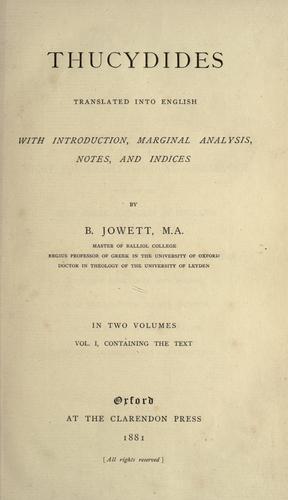 Thucydides · 400 BC · Greece (Athens)
Thucydides invented historical analysis in this account of Athens versus Sparta, read at every war college from Athens to West Point for two and a half millennia.
- 7
 Nicomachean Ethics 9.5/10Aristotle · 340 BC · Greece (Athens)
Aristotle's treatise on how to live well, the foundational text of Western moral philosophy and still, after twenty-three centuries, the clearest account of human flourishing ever written.
- 8
 Antigone 9/10Sophocles · 441 BC · Greece (Athens)
Sophocles's drama of a woman who defies the king to bury her brother, the founding Western statement of conscience against the state, debated every century since.
- 9
 The Histories 9/10Herodotus · 440 BC · Greece
Herodotus invented history writing in this sprawling account of the Persian Wars, the first European prose work to ask not just what happened but why.
- 10
 Medea 9/10Euripides · 431 BC · Greece (Athens)
Euripides's play of a woman who murders her own children to revenge a faithless husband, the most disturbing portrait of female rage in ancient literature.
- Free Download
Get the Great Books Wall Poster
All 350 books across 4,100 years, organized by era, with a checkbox for each. Print it, frame it, mark your progress. Enter your email and we'll send it over, plus the occasional reading path worth your time. No noise.
Free forever. Unsubscribe anytime. We never share your email.
- 11
 Politics 9/10Aristotle · 335 BC · Greece (Athens)
The first systematic treatise of political science, Aristotle classified the constitutions, defined the regime types, and set the agenda for every later political thinker.
- 12
 Metaphysics 9/10Aristotle · 335 BC · Greece (Athens)
Aristotle's investigation of being itself, the book that named the discipline of metaphysics and structured Western philosophy's deepest questions for twenty-three centuries.
- 13
 Elements 9/10Euclid · 300 BC · Greece (Alexandria)
Euclid's geometry textbook, the most successful textbook in human history, used continuously for two thousand three hundred years, still the model of how to build knowledge from axioms.
- 14
 The Bacchae 8.5/10Euripides · 405 BC · Greece (Athens)
Euripides's final tragedy, reason versus ecstasy, the civic order destroyed by the wild god Dionysus; Nietzsche's The Birth of Tragedy is essentially a commentary on it.
- 15
 Poetics 8.5/10Aristotle · 335 BC · Greece (Athens)
Aristotle invented literary criticism in this short treatise, catharsis, mimesis, the unities, the six elements of tragedy, the vocabulary every critic still uses.
- 16
 Parallel Lives 8.5/10Plutarch · 100 AD · Greece (Roman)
Plutarch paired Greek and Roman lives to illuminate virtue, the source Shakespeare mined for the Roman plays and the model for Western biographical writing for sixteen centuries.
- 17
 Theogony 8/10Hesiod · 700 BC · Greece
Hesiod's genealogy of the Greek gods, the mythological framework on which all Greek literature was built, and the text Herodotus said gave the Greeks their religion.
- 18
 Fragments 8/10Heraclitus · 500 BC · Greece (Ephesus)
Heraclitus's surviving fragments introduced the Logos, the flux doctrine, and the unity of opposites, concepts that shaped Plato, Hegel, Nietzsche, and Heidegger.
- 19
 Prometheus Bound 8/10Aeschylus (attr.) · 460 BC · Greece (Athens)
Attributed to Aeschylus, the Titan punished for giving fire to humanity; the archetype of rebellion against divine tyranny that shaped Romanticism, Marx, and every modern revolutionary.
- 20
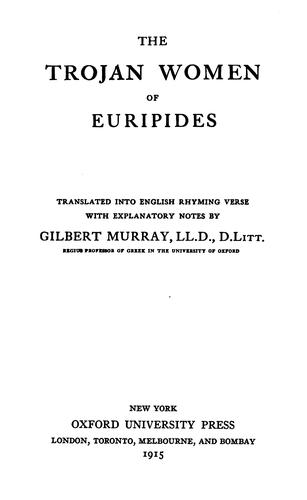 Trojan Women 8/10Euripides · 415 BC · Greece (Athens)
Euripides's 415 BC tragedy, the women of Troy after the city falls, the most candid anti-war play in ancient literature, revived in every major modern conflict.
- 21
 Works and Days 7.5/10Hesiod · 700 BC · Greece
Hesiod's seventh-century BC practical-wisdom poem, the Five Ages of Man, agricultural instruction, and the first European work of moral didactic verse; a direct model for Virgil.
- 22
 Fragments/Poems 7.5/10Sappho · 600 BC · Greece (Lesbos)
Sappho's surviving fragments, the invention of the personal lyric voice in Western poetry; Plato called her "the Tenth Muse" and no later poet has quite caught up.
- 23
 The Clouds 7.5/10Aristophanes · 423 BC · Greece (Athens)
Aristophanes's comedy mocking Socrates, Plato suggests in the Apology that the play's ridicule contributed to the atmosphere that produced Socrates's execution.
- 24
 Odes 7/10Pindar · 475 BC · Greece
Pindar's victory odes, the greatest ancient Greek choral lyric poet, whose elevated diction and dense imagery set the standard for the ode as a major literary form.
- 25
 The Persians 7/10Aeschylus · 472 BC · Greece (Athens)
Aeschylus's 472 BC play, the earliest surviving Greek tragedy, astonishingly sympathetic to the Persian enemy Athens had just defeated at Salamis.
Get the Great Books Wall Poster
All 350 books across 4,100 years, organized by era, with a checkbox for each. Print it, frame it, mark your progress. Enter your email and we'll send it over, plus the occasional reading path worth your time. No noise.
Free forever. Unsubscribe anytime. We never share your email.