Where to Buy
As an Amazon Associate I earn from qualifying purchases. Thanks for supporting the project.
Read / Listen Free
Trojan Women
8Euripides
Ranked 140th of 350 in the Great Books of Mankind catalog, scored 8/10. How we rank
Euripides's 415 BC tragedy, the women of Troy after the city falls, the most candid anti-war play in ancient literature, revived in every major modern conflict.
Get this book
ISBN 9781406903072Public-domain editions also available free, see below.
Summary & Critical Assessment (Score: 8/10)
Euripides' Trojan Women is a devastating anti-war dramas ever written, depicting the suffering of the women of Troy in the aftermath of their city's destruction. Its candid portrayal of the human cost of imperial violence has led to its revival during every major modern conflict.
The play was produced in 415 BCE, just one year before Athens launched the disastrous Sicilian Expedition, and in the same period that the Athenians massacred the population of Melos. Its critique of imperial violence spoke directly to the moral crisis of Athenian democracy. Jean-Paul Sartre adapted the play in 1965, and Michael Cacoyannis directed a notable film version in 1971, both drawing upon its themes to address contemporary warfare.
The Peloponnesian War, c. 430-400 BC
The Peloponnesian War (431-404 BC) pits Athens against Sparta. Plague kills Pericles (429 BC). The Sicilian Expedition ends in catastrophe. Athens massacres Melos. Socrates teaches in the agora. Despite crisis, literary production remains astonishing. Athens surrenders in 404 BC. Socrates is executed in 399 BC.
Awards & Adaptations
Sartre (1965). Cacoyannis film (1971). Anti-war revivals.
Recommended Edition
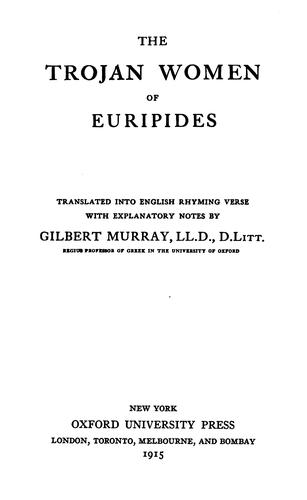
Gilbert Murray (1905)