Where to Buy
As an Amazon Associate I earn from qualifying purchases. Thanks for supporting the project.
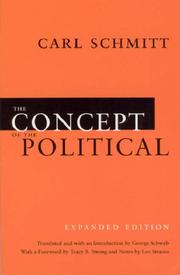
The Concept of the Political
8Carl Schmitt
Ranked 172nd of 350 in the Great Books of Mankind catalog, scored 8/10. How we rank
Schmitt's treatise, politics reduced to the friend/enemy distinction, the twentieth century's most penetrating critique of liberal democracy, whose influence on the authoritarian right remains undiminished.
Get this book
ISBN 9780226738925Summary & Critical Assessment (Score: 8/10)
The Concept of the Political is the work of the most important political theorist of the authoritarian right and arguably the twentieth century's most incisive critic of liberal democracy. Carl Schmitt's central thesis, that the essence of politics is the distinction between friend and enemy, stripped away liberal proceduralism to expose the raw power dynamics beneath constitutional order. His analysis of sovereignty, the state of exception, and political theology continues to challenge democratic theory.
Published the year before Hitler took power, functioning as both diagnosis and, unwittingly, blueprint, Schmitt's work emerged from the terminal crisis of the Weimar Republic. Leo Strauss's famous letter to Schmitt launched Strauss's career, and Giorgio Agamben's use of the "state of exception" concept brought Schmitt back to the center of political theory. The work is taught in every serious political theory program worldwide.
Depression-Era Literature, 1931-1932
The Depression deepens. Huxley's Brave New World imagines dystopia through pleasure. Celine's Journey revolutionizes French prose. Buck bridges East and West. Schmitt publishes The Concept of the Political the year before Hitler takes power, functioning as both a diagnosis of liberal democracy's crisis and, unwittingly, a blueprint. Japan invades Manchuria. The Weimar Republic enters its terminal crisis.
Awards & Adaptations
Foundation text of political realism. Taught in every serious political theory program. Leo Strauss's famous letter to Schmitt launched Strauss's career. The "state of exception" concept used by Agamben, adopted in post-9/11 debates on executive power.
Recommended Edition
George Schwab trans. (Rutgers, 1976; expanded ed. Chicago, 2007)