The 25 Greatest Plays Ever Written
From Sophocles and Euripides to Shakespeare, Chekhov, and Beckett: the form in which civilizations have staged their deepest arguments with themselves.
Drama is the oldest literary form that still gets staged in more or less the shape in which it was invented. The tragedies of Aeschylus, Sophocles, and Euripides, first performed in Athens in the fifth century BC, are still performed today, translated into every modern language, adapted in every generation, rewritten continuously by later playwrights. Shakespeare's thirty-seven plays, written between about 1590 and 1613, are the single most-performed body of work in any language. Chekhov's four late plays, The Seagull, Uncle Vanya, Three Sisters, The Cherry Orchard, are still the gold standard for what a well-made naturalist play can do.
What drama can do that no other form can quite match is to put an argument on stage and make it feel like something is at stake. A novel describes a conflict; a play enacts it. The audience watches a human being, in real time, working out a problem under pressure. This is why the great moments of political crisis so often generate great plays, the Athenians writing about civil war, Shakespeare writing about succession under Elizabeth, Schiller writing about liberty under the Prussian censors, Ibsen writing about bourgeois hypocrisy, Brecht writing about fascism, Beckett writing about the absence of meaning after the war.
The list below includes works the catalog tags as drama (or hybrid drama/poetry, drama/music), ranked by Great Books of Mankind score with chronological order breaking ties. The Greeks and Shakespeare dominate the top of the list, a fair reflection of how dramatic literature is actually valued, but the modern masters are well represented.
For the Shakespearean canon specifically, see the entry for the Complete Works (First Folio). For the Greek tradition that made Western drama possible, see the greatest works of Greek literature.
Buy links are affiliate links. As an Amazon Associate I earn from qualifying purchases. We are also a Bookshop.org affiliate and earn from qualifying purchases there.
Get the Great Books Wall Poster
All 350 books across 4,100 years, organized by era, with a checkbox for each. Print it, frame it, mark your progress. Enter your email and we'll send it over, plus the occasional reading path worth your time. No noise.
Free forever. Unsubscribe anytime. We never share your email.
- 1
 Oedipus Rex 10/10Sophocles · 429 BC · Greece (Athens)
Sophocles wrote the play that defined tragedy itself, the form Aristotle dissected, Freud diagnosed, and every dramatist since has tried to escape.
- 2
 William Shakespeare · 1623 AD · England
The collected plays of the writer who, more than any other, shaped how speakers of English think, feel, and curse, preserved by two friends seven years after his death.
- 3
 Faust (Parts I & II) 10/10J.W. von Goethe · 1832 AD · Germany
Goethe's lifelong drama of a man who sells his soul for knowledge, the founding modern myth of overreach and the cost of becoming the person you wanted to be.
- 4
 The Oresteia 9.5/10Aeschylus · 458 BC · Greece (Athens)
Aeschylus's trilogy traces the birth of justice itself, the moment a civilization replaces blood vengeance with the institution of the law court.
- 5
 Antigone 9/10Sophocles · 441 BC · Greece (Athens)
Sophocles's drama of a woman who defies the king to bury her brother, the founding Western statement of conscience against the state, debated every century since.
- 6
 Medea 9/10Euripides · 431 BC · Greece (Athens)
Euripides's play of a woman who murders her own children to revenge a faithless husband, the most disturbing portrait of female rage in ancient literature.
- 7
 Waiting for Godot 9/10Samuel Beckett · 1952 AD · France (Ireland)
Beckett's 1952 play, two tramps waiting for someone who never arrives, stripped drama to its bones and invented absurdist theatre in a single stage.
- 8
 The Bacchae 8.5/10Euripides · 405 BC · Greece (Athens)
Euripides's final tragedy, reason versus ecstasy, the civic order destroyed by the wild god Dionysus; Nietzsche's The Birth of Tragedy is essentially a commentary on it.
- 9
 Dom Juan 8.5/10Molière (Jean-Baptiste Poquelin) · 1665 AD · France
Molière's 1665 comedy created one of Western culture's defining archetypes, the libertine seducer who would reappear in Mozart, Byron, Kierkegaard, and Camus.
- 10
 The Misanthrope / Tartuffe 8.5/10Molière (Jean-Baptiste Poquelin) · 1666 AD · France
Molière's greatest comedies, Tartuffe attacked religious hypocrisy so effectively Louis XIV banned it; his body of work is to French comedy what Shakespeare is to English drama.
- Free Download
Get the Great Books Wall Poster
All 350 books across 4,100 years, organized by era, with a checkbox for each. Print it, frame it, mark your progress. Enter your email and we'll send it over, plus the occasional reading path worth your time. No noise.
Free forever. Unsubscribe anytime. We never share your email.
- 11
 The Ring of the Nibelung 8.5/10Richard Wagner · 1876 AD · Germany
Wagner's four-opera sixteen-hour cycle, the greatest work of music drama ever composed, and the aesthetic event that defined late nineteenth-century European culture.
- 12
 Collected Stories 8.5/10Anton Chekhov · 1888 AD · Russian Empire
Chekhov's stories and plays, The Cherry Orchard, Three Sisters, Uncle Vanya, perfected an art of suggestion and understatement that shaped every later short-story writer.
- 13
 Prometheus Bound 8/10Aeschylus (attr.) · 460 BC · Greece (Athens)
Attributed to Aeschylus, the Titan punished for giving fire to humanity; the archetype of rebellion against divine tyranny that shaped Romanticism, Marx, and every modern revolutionary.
- 14
 Trojan Women 8/10Euripides · 415 BC · Greece (Athens)
Euripides's 415 BC tragedy, the women of Troy after the city falls, the most candid anti-war play in ancient literature, revived in every major modern conflict.
- 15
 A Doll's House 8/10Henrik Ibsen · 1879 AD · Norway
Ibsen's 1879 play, Nora slamming the door on her marriage was called "the door slam heard round the world," and founded modern realist drama.
- 16
 Bertolt Brecht · 1941 AD · Germany
Brecht's 1941 epic theatre masterwork, the anti-war play that invented the alienation effect and shaped twentieth-century drama, film, and political rhetoric.
- 17
 Eugene O'Neill · 1956 AD · United States
O'Neill's autobiographical tragedy and his Aeschylean trilogy, the peak of American drama, from the only American playwright ever awarded the Nobel.
- 18
 The Clouds 7.5/10Aristophanes · 423 BC · Greece (Athens)
Aristophanes's comedy mocking Socrates, Plato suggests in the Apology that the play's ridicule contributed to the atmosphere that produced Socrates's execution.
- 19
 Pygmalion / Saint Joan 7.5/10George Bernard Shaw · 1913 AD · Britain (Ireland)
Shaw's great comedy (adapted as My Fair Lady) and his historical drama, the most intellectually provocative English-language playwright since Shakespeare.
- 20
 Luigi Pirandello · 1921 AD · Italy
Pirandello's 1921 meta-theatrical play, characters walking onto a stage demanding their story be finished; the founding work of twentieth-century meta-drama.
- 21
 Wole Soyinka · 1965 AD · Nigeria
Soyinka's plays fusing Yoruba ritual with Greek tragic structure, in 1986 the first African Nobel laureate in Literature.
- 22
 The Homecoming / Betrayal 7.5/10Harold Pinter · 1965 AD · Britain
Pinter's plays, menace, ellipsis, pauses so precisely weighted "Pinteresque" entered English as an adjective; the most influential postwar British dramatist.
- 23
 The Persians 7/10Aeschylus · 472 BC · Greece (Athens)
Aeschylus's 472 BC play, the earliest surviving Greek tragedy, astonishingly sympathetic to the Persian enemy Athens had just defeated at Salamis.
- 24
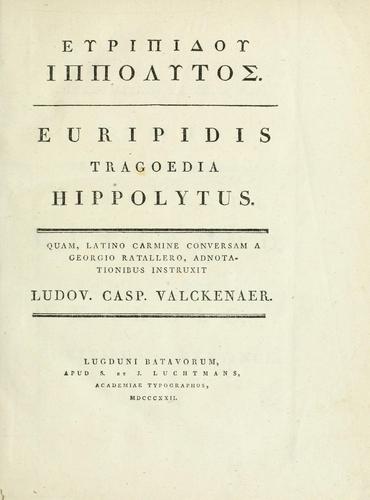 Hippolytus 7/10Euripides · 428 BC · Greece (Athens)
Euripides's tragedy of Phaedra and her stepson, the primary source for Racine's Phèdre and the template for every later drama of forbidden desire.
- 25
 Lysistrata 7/10Aristophanes · 411 BC · Greece (Athens)
Aristophanes's 411 BC comedy, the women of Greece striking for sex to end the war; still revived during every major contemporary conflict.
Get the Great Books Wall Poster
All 350 books across 4,100 years, organized by era, with a checkbox for each. Print it, frame it, mark your progress. Enter your email and we'll send it over, plus the occasional reading path worth your time. No noise.
Free forever. Unsubscribe anytime. We never share your email.