Where to Buy
As an Amazon Associate I earn from qualifying purchases. Thanks for supporting the project.
Read / Listen Free
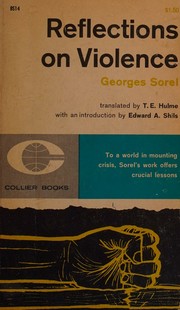
Reflections on Violence
7Georges Sorel
Ranked 268th of 350 in the Great Books of Mankind catalog, scored 7/10. How we rank
Sorel's 1908 treatise, politics as driven by myth, not rational programs; the intellectual bridge between revolutionary socialism and fascism, and a book whose influence exceeds its readership.
Get this book
ISBN 9780486437071Public-domain editions also available free, see below.
Summary & Critical Assessment (Score: 7/10)
Reflections on Violence stands as the intellectual bridge between revolutionary socialism and fascism, a work whose influence on twentieth-century politics far exceeds its readership. Georges Sorel's central argument, that political movements are driven not by rational programs but by galvanizing "myths," and that violence can serve as a morally regenerative force, shaped political theory across the ideological spectrum.
Issued during the syndicalist movement's peak, as France's Third Republic weathered the aftermath of the Dreyfus Affair, Sorel broke with orthodox socialism to argue that the general strike functions as a mobilizing myth rather than a practical strategy. Mussolini cited Sorel as foundational, while Walter Benjamin, Carl Schmitt, and Isaiah Berlin all engaged deeply with his ideas. The concept of political myth remains central to political theory.
Europe, 1905-1908
The old order trembles. Russia's 1905 revolution shakes the autocracy. Einstein publishes special relativity. The syndicalist movement peaks in France. Weber writes during the Second Industrial Revolution as Germany rivals Britain economically. The Dreyfus Affair's aftermath reshapes French politics. Picasso paints Les Demoiselles d'Avignon. The foundations of twentieth-century social thought are being laid.
Awards & Adaptations
Cited by Mussolini as foundational. Influenced Walter Benjamin, Carl Schmitt, Isaiah Berlin (who wrote an important essay on Sorel). The "myth" concept remains central to political theory.
Recommended Edition
T.E. Hulme trans. (1915); Jeremy Jennings trans. (Cambridge, 1999)