Where to Buy
As an Amazon Associate I earn from qualifying purchases. Thanks for supporting the project.
Read / Listen Free
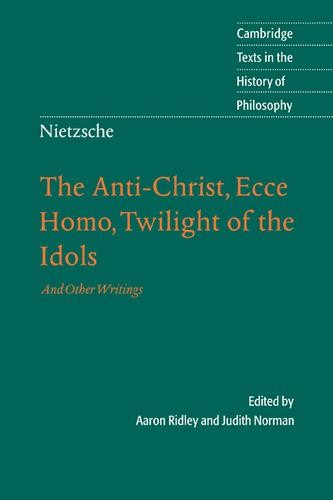
Twilight of the Idols / The Anti-Christ / Ecce Homo
8.5Friedrich Nietzsche
Ranked 105th of 350 in the Great Books of Mankind catalog, scored 8.5/10. How we rank
Nietzsche's late masterpieces, written in his final productive year, "philosophy with a hammer," the most ferocious attack on Christianity ever composed, and his own autobiography.
Get this book
ISBN 9781107385726Public-domain editions also available free, see below.
Summary & Critical Assessment (Score: 8.5/10)
Twilight of the Idols, The Anti-Christ, and Ecce Homo represent Friedrich Nietzsche's late masterworks, composed in a burst of remarkable creative intensity during his final productive year. Twilight of the Idols, subtitled "How One Philosophizes with a Hammer," systematically dismantles the cherished assumptions of Western thought; The Anti-Christ mounts a full-scale assault on Christianity as a religion of weakness and resentment; and Ecce Homo provides a unique intellectual autobiography in which Nietzsche reviews his own body of work with characteristic audacity and self-awareness.
All three works were written in 1888, Nietzsche's final year of productive activity before his mental collapse in Turin in January 1889. Twilight of the Idols was the last work Nietzsche himself prepared for publication, while Ecce Homo and The Anti-Christ were published posthumously. Together, these late works represent the culmination of Nietzsche's philosophical project, synthesizing and sharpening the themes that had occupied him throughout his career.
Europe, 1888-1891
Fin de siecle. Chekhov emerges as the master of the short story. Wilde publishes Dorian Gray. Hamsun writes Hunger in Norway. Hardy publishes Tess. Frazer's Golden Bough compiles mythology from across the British Empire, providing the intellectual catalyst for literary modernism. Jack the Ripper terrorizes London. Bismarck falls from power. Van Gogh dies. Ibsen and Strindberg dominate Scandinavian theater. The century's end approaches with both decadence and creative ferment.
Awards & Adaptations
Core in Nietzsche studies. Stanford Complete Works Vol. 9.
Recommended Edition
Stanford UP: Complete Works Vol. 9, trans. A.U. Sommer (2021)
Frequently Asked Questions
When was Twilight of the Idols / The Anti-Christ / Ecce Homo written?
Who wrote Twilight of the Idols / The Anti-Christ / Ecce Homo?
Why is Twilight of the Idols / The Anti-Christ / Ecce Homo considered a great book?
What language was Twilight of the Idols / The Anti-Christ / Ecce Homo originally written in?
What's the best edition or translation of Twilight of the Idols / The Anti-Christ / Ecce Homo?
Where can I read Twilight of the Idols / The Anti-Christ / Ecce Homo for free?
Explore More
Related Books