Where to Buy
As an Amazon Associate I earn from qualifying purchases. Thanks for supporting the project.
Read / Listen Free
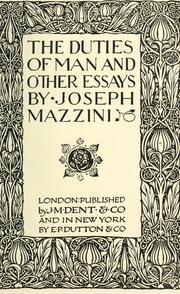
The Duties of Man
7.5Giuseppe Mazzini
Ranked 209th of 350 in the Great Books of Mankind catalog, scored 7.5/10. How we rank
Mazzini's treatise and the ideological architecture of Italian unification, the most influential theorist of nineteenth-century democratic nationalism and a shaping influence on everyone from Weizmann to Gandhi.
Get this book
ISBN 9780460002240Public-domain editions also available free, see below.
Summary & Critical Assessment (Score: 7.5/10)
The Duties of Man is the work of the ideological architect of Italian unification and the most influential theorist of nineteenth-century democratic nationalism. Giuseppe Mazzini's framework of "duties over rights," arguing that freedom entails moral obligation to community, nation, and humanity, provided the ethical foundation for the Risorgimento and influenced liberation movements across the globe.
Begun as the Risorgimento reached its climax, with Garibaldi's Expedition of the Thousand conquering Sicily and Naples and the proclamation of the Kingdom of Italy, Mazzini's work established the principle of national self-determination that would reshape international law. Woodrow Wilson's Fourteen Points bore Mazzini's imprint, and both Gandhi and Nehru acknowledged his influence on their own struggles for independence.
Italy, 1860
The Risorgimento reaches its climax. Garibaldi's Expedition of the Thousand conquers Sicily and Naples. Cavour maneuvers diplomatically. Victor Emmanuel II is proclaimed King of Italy in 1861. Mazzini, the ideological architect of unification, writes from exile. Lincoln is elected president in America. Darwin's Origin of Species appeared the previous year. European nationalism reshapes the continent's political map.
Awards & Adaptations
Influenced Wilson's Fourteen Points. Gandhi and Nehru read Mazzini. Foundation of the self-determination principle in international law. Core text in Italian political thought.
Recommended Edition
Thomas Jones trans. (Everyman's Library, 1907); Leopold Classic Library (2015)