Where to Buy
As an Amazon Associate I earn from qualifying purchases. Thanks for supporting the project.
Read / Listen Free
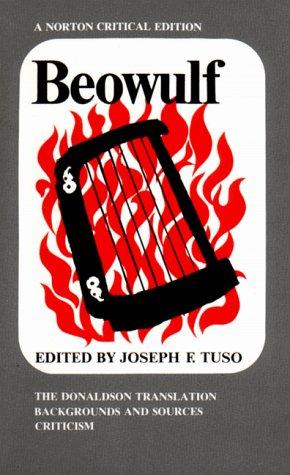
Beowulf
8.5Anonymous
Ranked 72nd of 350 in the Great Books of Mankind catalog, scored 8.5/10. How we rank
The greatest surviving work of Old English literature, an eighth-century epic that Tolkien's 1936 essay rescued from the philologists and restored to the canon.
Get this book
ISBN 9781421933313Public-domain editions also available free, see below.
Summary & Critical Assessment (Score: 8.5/10)
Beowulf is the greatest surviving work of Old English literature and the foundation of the English literary tradition. J.R.R. Tolkien's turning-point 1936 essay transformed the study of the poem by arguing for its merit as a work of literary art rather than merely a historical document, and Seamus Heaney's acclaimed 1999 translation brought it to a vast modern readership.
The poem survives in a single manuscript that was nearly destroyed in the Cotton Library fire of 1731. In November 1936, J.R.R. Tolkien delivered "Beowulf: The Monsters and the Critics" to the British Academy, arguing that the poem should be read as a sophisticated work of art rather than a historical or linguistic artifact. The lecture is widely credited with rescuing Beowulf from the philologists and reviving the literary interest that produced every major modern translation since. For modern English readers, Seamus Heaney (1999) is the standard literary choice and Maria Dahvana Headley (2020) the boldest contemporary recreation; serious students should also consider R.D. Fulk's facing-page edition (2010), R.M. Liuzza's revised 2nd edition (2012), and Tom Shippey's posthumous translation edited by Leonard Neidorf (2024). Translation recommendations drawn from Graham Scheper, "What is the BEST Beowulf Translation?" (2025).
Early Medieval Europe, c. 750
Charlemagne's conquests reshape Western Europe. The Carolingian Renaissance revives Latin learning. Anglo-Saxon culture produces Beowulf. Vikings begin their raids. The Abbasid Caliphate presides over the Islamic Golden Age. Tang Dynasty China under the great poets represents the world's most sophisticated civilization.
Awards & Adaptations
Tolkien's essay. Heaney (1999). Core at Oxford/Princeton.
Recommended Edition
Seamus Heaney (Faber & Faber, 1999); Maria Dahvana Headley (FSG, 2020)