Where to Buy
As an Amazon Associate I earn from qualifying purchases. Thanks for supporting the project.
The Castle
8Franz Kafka
Ranked 171st of 350 in the Great Books of Mankind catalog, scored 8/10. How we rank
Kafka's unfinished posthumous novel, a land surveyor endlessly denied access to the mysterious authorities of the village, the ultimate parable of bureaucratic power.
Get this book
ISBN 9781398855953Summary & Critical Assessment (Score: 8/10)
Franz Kafka's The Castle presents an impenetrable bureaucratic world in which a land surveyor struggles endlessly to gain access to the mysterious authorities who govern the village where he has arrived. Left unfinished at Kafka's death and published posthumously, it stands as a powerful existential parables in modern literature, a vision of alienation and thwarted purpose that resonates across cultures and eras.
Originally published in 1926, two years after Kafka's death, The Castle entered a European literary landscape increasingly preoccupied with questions of authority, belonging, and individual helplessness before institutional power. The novel's labyrinthine structure and ambiguous symbolism have generated an notable range of interpretations, theological, political, psychoanalytic, securing its place as a central text of twentieth-century fiction.
Weimar Culture, 1924-1926
The Weimar Republic's golden years. Mann publishes The Magic Mountain. Kafka's works appear posthumously. Hitler writes Mein Kampf in prison. The Bauhaus flourishes. Fitzgerald captures the Jazz Age. Woolf invents stream-of-consciousness narrative. Pound begins publishing The Cantos, his lifelong modernist epic, while living in Italy and increasingly drawn to Mussolini's regime. Hemingway's The Sun Also Rises and the Paris expatriate scene define the Lost Generation.
Awards & Adaptations
Core in modern lit.
Recommended Edition
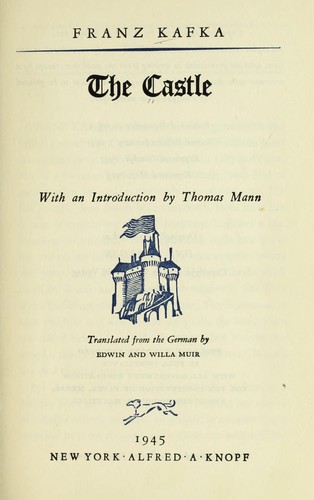
Willa & Edwin Muir (1930)