Where to Buy
As an Amazon Associate I earn from qualifying purchases. Thanks for supporting the project.
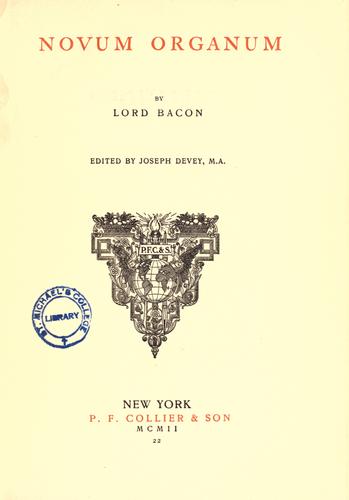
Novum Organum
8Francis Bacon
Ranked 146th of 350 in the Great Books of Mankind catalog, scored 8/10. How we rank
Bacon's 1620 manifesto for the empirical scientific method, the Four Idols, inductive reasoning, and the intellectual program that produced the Scientific Revolution.
Get this book
ISBN 9783787307579Summary & Critical Assessment (Score: 8/10)
Francis Bacon's Novum Organum is the foundation of the empirical scientific method, introducing the principles of inductive reasoning that would transform humanity's understanding of the natural world. Its doctrine of the Four Idols, the systematic biases that distort human thinking, remains a penetrating analyses of cognitive error ever articulated.
Part of Bacon's ambitious Great Instauration, the Novum Organum identified four categories of cognitive bias (the Idols of the Tribe, Cave, Marketplace, and Theater) that continue to resonate in modern discussions of critical thinking and scientific method. The work shaped the founding of the Royal Society and the development of empirical science as the dominant mode of inquiry in the modern world.
Shakespeare & Cervantes, c. 1605-1623
Shakespeare and Cervantes die the same year (1616). Don Quixote, the first modern novel, appears while Shakespeare produces his greatest plays. The King James Bible (1611), commissioned by James I and translated by 47 scholars, gives English-speaking Protestantism its defining sacred text and profoundly shapes English prose for centuries. England's break from Rome under Henry VIII (1534) and the defeat of Spain's Armada (1588) have established England as a rising Protestant naval power; the KJV consolidates this identity. Jamestown is founded (1607). Galileo turns his telescope skyward. Bacon's Novum Organum lays foundations of empirical science.
Awards & Adaptations
Foundation of empirical science.
Recommended Edition
J. Spedding et al. (1857-74)